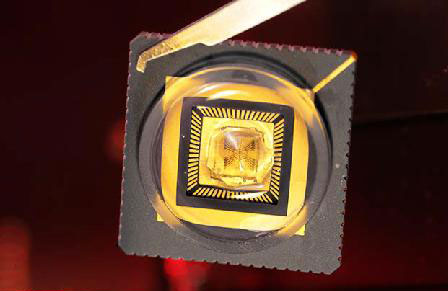
As you see from the blogs here, nanotechnology, neuroscience, electronics and hi-tech materials are already replacing whole limbs and organs in a fast developing field of science
By the end of the year researchers will try out the first bionic eye implant in the UK hoping to help a blind patient see for the first time.
Check out this cool BBC news interactive page for a rundown of what's going on/
We've been cramming more intricate engineering into our bodies than you might think. For more on this fascinating subject, check out The Bionic Body Shop
Lightning seed: Tough, relentless cyberpunk action.
In an icebound future, fanatics with an dangerously unstable, climate transforming WMD, plan to fix the weather and save the world. The only person with the disarm codes has amnesia. It's down to a war-weary veteran to keep him alive in a deadly chase across a haunted America to reach the bomb
Kindle: http://bit.ly/LS-US
Google http://bit.ly/LS-CT
I write Scifi. I've moved the blog to http://www.softmachine.net You'll find all the new stuff there @NathanMcGrathSF. Nathan.
Monday, 5 March 2012
Prosthetics controlled like real limbs
| Major advances in neuroscience could lead to a wider range of brain-controlled prosthetic limbs that can restore mobility for people. (Credit: © ktsdesign / Fotolia) |
Their new study, published March 4 in the advanced online publication of the journal Nature, shows that through a process called plasticity, parts of the brain can be trained to do something they normally do not do; like controlling a prosthetic limb for example.
The new study advances work by researchers who have been studying the brain circuits used in natural movement in order to mimic them for the development of prosthetic devices.
"What we hope is that our new insights into the brain's wiring will lead to a wider range of better prostheses that feel as close to natural as possible," said Jose Carmena, UC Berkeley associate professor of electrical engineering, cognitive science and neuroscience.
Full Story at Science Daily 04-03-2012
Sunday, 4 March 2012
Solar Flare could frazzle world's circuits.
| Solar flares (credit: SOHO/NASA/ESA) |
The Earth has a roughly 12 percent chance of experiencing an enormous megaflare erupting from the sun in the next decade, according to space physicist Pete Riley, senior scientist at Predictive Science in San Diego, California, writing n Space Weather on Feb. 23.
This event could potentially cause trillions of dollars’ worth of damage and take up to a decade to recover from, according to a 2008 report from the National Research Council.
The last gigantic solar storm, known as the Carrington Event, occurred more than 150 years ago and was the most powerful such event in recorded history.
Ref.: Pete Riley, On the probability of occurrence of extreme space weather events. Space Weather, 2012 [DOI: 10.1029/2011SW000734] (Source: Kurzweil)
Project HAARP. Brollies will be useless against this threat
US Military working on Weather control?
HAARP began in 1990 and is funded by the Office of Naval Research jointly with the Air Force Research Laboratory. Its official purpose is to "analyze the ionosphere and investigate the potential for developing ionospheric enhancement technology for radio communications and surveillance purposes."
This invention has a phenomenal variety of possible ramifications and potential future developments. As alluded to earlier, missile or aircraft destruction, deflection, or confusion could result. particularly when relativistic particles are employed. Also. large regions of the atmosphere could be lifted to an unexpectedly high altitude so that missiles encounter unexpected and unplanned drag forces with resultant destruction or deflection of same. Weather modification is possible by, for example, altering upper atmosphere wind patterns or altering solar absorption patterns by constructing one or more plumes of atmospheric particles which will act as a lens or focusing device.
Read More on Project HAARP
HAARP began in 1990 and is funded by the Office of Naval Research jointly with the Air Force Research Laboratory. Its official purpose is to "analyze the ionosphere and investigate the potential for developing ionospheric enhancement technology for radio communications and surveillance purposes."
This invention has a phenomenal variety of possible ramifications and potential future developments. As alluded to earlier, missile or aircraft destruction, deflection, or confusion could result. particularly when relativistic particles are employed. Also. large regions of the atmosphere could be lifted to an unexpectedly high altitude so that missiles encounter unexpected and unplanned drag forces with resultant destruction or deflection of same. Weather modification is possible by, for example, altering upper atmosphere wind patterns or altering solar absorption patterns by constructing one or more plumes of atmospheric particles which will act as a lens or focusing device.
Read More on Project HAARP
Saturday, 3 March 2012
Neural implants to replace damaged sensory cells
| Biocompatible chips made of graphene. |
(Nanowerk News) In the future, neural implants could replace destroyed sensory cells in the eye or ear – a dream come true for humanity.
One of the greatest challenges yet to be addressed is designing the interface between medical technology and human tissue.
In order to overcome the limitations of existing models, scientists from Forschungszentrum Juelich and eleven other institutions involved in the NeuroCare project, which kicked off on 1 March 2012, will develop novel biointerfaces made of carbon.
If you are a regular visitor to this blog, you will know nanoparticles can be absorbed by the body through the skin or via ingestion as part of foods where nanotechnology is part of of the production process.
You will also have read about nanoscale wireless communication.
It is a commonly held rule that technologies converge and it takes little imagination to consider the dangers of neuro and nanotechnology convergence.
The world of Alister Cloud is one possible future where these convergences have already taken place.
Set in a society where governments depend upon ruthless Private Military Companies willing to use any technological advantage to retain contracts and control, the book explores the darker side of today's emerging technologies.
| At the end of 2011, researchers from Forschungszentrum Jülich and Technische Universität München grew cardiac cells on a graphene transistor. |
Thursday, 1 March 2012
The Greeks, the riots, the dog.
One committed protester has been at the front line of Greece protests for years.
The dog, thought to be a stray called Loukanikos, or Sausage, has become both a symbol and inspiration for Greek protesters, showing no fear, always in the action, constantly barking down police.
Anonymous take down Interpol Website
The Guardian Reports the following
"Interpol's website appears to have been the victim of a cyber-attack after the international police agency announced the arrests of 25 suspected members of the hacking activist group Anonymous in Europe and South America.
The website went down briefly on Tuesday as supporters of Anonymous made online claims that it had been targeted following the arrests in Argentina, Chile, Colombia and Spain. It was quickly back up and running but was loading slowly."Full story on the >Jump Here<
Get involved in the Public Consultation on Neurotechnology
| From Nuffield Council on Bioethics website |
Recent developments in Neurology, computing and nanotechnology have led to methods of enabling the brain to directly control computers and thereby machinery; computers that can translate or 'read' thoughts, methods of influencing our thoughts and emotions.
As a result, the Nuffield Council on Bioethics has launched a public consultation on the ethics of the technology. Download the consultation doc and give your feedback. You don't need to be an academic or researcher to tell them what you think of the emerging technologies and if you would use them should the need or opportunity arise. Go on, get involved. You can download the consultation paper from the link on the Nuffield Council on Bioethics page
| Image from BBC News |
"Hopes of curing terrible diseases, and fears about the consequences of trying to enhance human capability beyond what is normally possible.
"These challenge us to think carefully about fundamental questions to do with the brain: what makes us human, what makes us an individual, and how and why do we think and behave in the way we do."
For More information and to contribute to the consultation, go to the Nuffield Council on Bioethics page here
Wednesday, 29 February 2012
Wi-fi on an atomic scale - the perfect fit
ScienceDaily (Feb. 28, 2012) — We know since the dawn of modern physics that although events in our everyday life can be described by classical physics, the interaction of light and matter is down deep governed by the laws of quantum mechanics. Despite this century-old wisdom, accessing truly quantum mechanical situations remains nontrivial, fascinating and noteworthy even in the laboratory. Recently, interest in this area has been boosted beyond academic curiosity because of the potential for more efficient and novel forms of information processing.
Alister's SoftMachine outfit is a morphing, colour changing outfit that receives instructions from both Alister and the world's most powerful supercomputer. The wireless function is built into the nanomaterial of the outfit.
Here's a rehash exercise I undertook of the Science Daily article just to help me understand what had been achieved
"A single atom or molecule acts as a quantum bit processing signals delivered via single photons.
It is possible to set up a situation where single molecules can be detected and single photons generated.
The problem is putting together a simple one on one interaction because billions of photons per second are usually impinged on a molecule to obtain a signal from it.
First off, you would have to find a suitable source of single photons, which have the proper frequency and bandwidth. Although lasers come in different colours and specifications, something that fires single photons can't be bought at Maplins or Radio Shack
One common way to get around this difficulty in atomic physics is to build a cavity around the atom so that a photon remains trapped for long enough times to increase the chances of a 1-1 interaction.
And it's been done. Connecting a single flying photon with a single molecule.
So a team of scientists (at ETH Zurich and Max Planck Institute for the Science of Light in Erlangen) led by Professor Vahid Sandoghdar made something that spits out single photons.
How? Well they cheated a little by using a photon release event that happens naturally. When an atom or molecule absorbs a photon it makes a transition to a so-called excited state. After a few nanoseconds (one thousand millionth of a second) this state decays to its initial ground state and emits exactly one photon.
So the group used two samples of fluorescent molecules embedded in organic crystals and cooled them to about 1.5 K (-272 °C). Single molecules in each sample were detected by a combination of spectral and spatial selection.
To generate single photons, a single molecule was excited in the “source” sample and when the excited state of the molecule decayed, the emitted photons were collected and tightly focused onto the “target” sample at a distance of a few meters.
The team had to (1) make sure the photon and the molecule had the same frequency; and (2) get the single photons to interact with the target molecule in an efficient manner.
Not that easy when the focus of a light beam cannot be smaller than a few hundred nanometers; while a molecule is about one nanometer in size (100,000 times smaller than the diameter of a human hair); which would lead to most of the incoming light (photons) going around the molecule, i.e. without them seeing each other.
Here's the 'but'; if the incoming photons are resonant with the quantum mechanical transition of the molecule, the molecule acts more like a prefect little catchers glove to the area of the focused light and grabs the light waves in its vicinity.
The experimental work was performed at ETH Zurich before the group of Prof. Sandoghdar moved to the newly founded Max Planck Institute for the Science of Light in Erlangen in 2011."
Alister's SoftMachine outfit is a morphing, colour changing outfit that receives instructions from both Alister and the world's most powerful supercomputer. The wireless function is built into the nanomaterial of the outfit.
Here's a rehash exercise I undertook of the Science Daily article just to help me understand what had been achieved
"A single atom or molecule acts as a quantum bit processing signals delivered via single photons.
It is possible to set up a situation where single molecules can be detected and single photons generated.
The problem is putting together a simple one on one interaction because billions of photons per second are usually impinged on a molecule to obtain a signal from it.
First off, you would have to find a suitable source of single photons, which have the proper frequency and bandwidth. Although lasers come in different colours and specifications, something that fires single photons can't be bought at Maplins or Radio Shack
One common way to get around this difficulty in atomic physics is to build a cavity around the atom so that a photon remains trapped for long enough times to increase the chances of a 1-1 interaction.
And it's been done. Connecting a single flying photon with a single molecule.
So a team of scientists (at ETH Zurich and Max Planck Institute for the Science of Light in Erlangen) led by Professor Vahid Sandoghdar made something that spits out single photons.
How? Well they cheated a little by using a photon release event that happens naturally. When an atom or molecule absorbs a photon it makes a transition to a so-called excited state. After a few nanoseconds (one thousand millionth of a second) this state decays to its initial ground state and emits exactly one photon.
So the group used two samples of fluorescent molecules embedded in organic crystals and cooled them to about 1.5 K (-272 °C). Single molecules in each sample were detected by a combination of spectral and spatial selection.
To generate single photons, a single molecule was excited in the “source” sample and when the excited state of the molecule decayed, the emitted photons were collected and tightly focused onto the “target” sample at a distance of a few meters.
The team had to (1) make sure the photon and the molecule had the same frequency; and (2) get the single photons to interact with the target molecule in an efficient manner.
Not that easy when the focus of a light beam cannot be smaller than a few hundred nanometers; while a molecule is about one nanometer in size (100,000 times smaller than the diameter of a human hair); which would lead to most of the incoming light (photons) going around the molecule, i.e. without them seeing each other.
Here's the 'but'; if the incoming photons are resonant with the quantum mechanical transition of the molecule, the molecule acts more like a prefect little catchers glove to the area of the focused light and grabs the light waves in its vicinity.
The experimental work was performed at ETH Zurich before the group of Prof. Sandoghdar moved to the newly founded Max Planck Institute for the Science of Light in Erlangen in 2011."
IBM close to Working Quantum Computer
Monday, 27 February 2012
Free Links to Increase your browsing privacy
Increase your browsing privacy
On March 1st, Google will implement its new, unified privacy policy, which will affect data Google has collected on you prior to March 1st as well as data it collects on you in the future. Earlier this week, we showed you how to delete your Google Web History in order to prevent Google from combining your Web History data with the data it has about you on its other products to provide you with personalized ads or suggestions across all of its products. You may also wish to delete your YouTube Viewing and Search History, which can reveal particularly sensitive information about you, including your location, interests, age, sexual orientation, religion, and health concerns.
The Electronic Frontier Foundation has produced some invaluable yet simple guides on steps you can take to increase your privacy when browsing the web; not just from Google but all the other corporate residents that make use of the data they gather on your browsing activity.
The Link Here provides more help
Ever asked yourself 'What is Matter?'
Saturday, 25 February 2012
Nanomaterials and the 'do anything you want' outfit.
ScienceDaily (Feb. 24, 2012) — Researchers at the NanoScience Center of the University of Jyväskylä, Finland, and at Harvard University, US, have discovered a novel way to make nanomaterials. Computer simulations predict that long and narrow graphene nanoribbons can be rolled into carbon nanotubes by means of twisting. Being classical in origin, the mechanism is robust and valid on the macro-, micro- and nanoscale.
The mechanism also enables experimental control, which has earlier been impossible. The mechanism can be used to make various kinds of novel carbon nanotubes, to encapsulate molecules insides the tubes, or to make tubules from ribbons made out of other planar nanomaterials.
For the past twenty years, carbon nanotubes have been described as "rolled-up graphenes," even though no-one ever really did the rolling. Today, nanotubes, along with many other nanomaterials, are made by atom-by-atom growth.
The results were published in Physical Review B. The research used the computer resources of the Finnish IT Centre for Science (CSC), based in Espoo.
Part Two.
Add to this a couple of other developments reported here in the blog. (a) atom sized transistors and (b) technologies powered by touch and, boom: a computer woven into the nanomaterials of your clothing and powered by the kinetic and thermal energy produced by your movement.
Elsewhere here you'll find posts on brain-machine interfaces. It is feasible to consider a material containing nanotechnology components with different functions; one of which will be to allow manipulation of the different technologies in the outfit by thought alone.
The mechanism also enables experimental control, which has earlier been impossible. The mechanism can be used to make various kinds of novel carbon nanotubes, to encapsulate molecules insides the tubes, or to make tubules from ribbons made out of other planar nanomaterials.
For the past twenty years, carbon nanotubes have been described as "rolled-up graphenes," even though no-one ever really did the rolling. Today, nanotubes, along with many other nanomaterials, are made by atom-by-atom growth.
The results were published in Physical Review B. The research used the computer resources of the Finnish IT Centre for Science (CSC), based in Espoo.
Part Two.
Add to this a couple of other developments reported here in the blog. (a) atom sized transistors and (b) technologies powered by touch and, boom: a computer woven into the nanomaterials of your clothing and powered by the kinetic and thermal energy produced by your movement.
Elsewhere here you'll find posts on brain-machine interfaces. It is feasible to consider a material containing nanotechnology components with different functions; one of which will be to allow manipulation of the different technologies in the outfit by thought alone.
Thursday, 23 February 2012
Nanotechnology, neuroscience, bye bye free will..
In June 2009. Honda came up with a new Brain-Machine Interface helmet that gave the user power to communicate telepathically with humanoids. It reads your thoughts by measuring changes in electrical current and blood flow in the brain.
Things have moved on from then. Developments in nanotechnology means that data can now flow in two directions.
take the New Scientist article (reported in io9): " For the first time ever, scientists can control human brain cells using quantum dots
What if you could treat conditions ranging from Alzheimer's to blindness, all with a flash of light? Researchers think it's possible — and they plan on using tiny particles called quantum dots to do it.
Brain stimulation can be incredibly tricky. Performing it from outside the head is effective, but doesn't give you very much specificity when it comes to turning on a specific brain region...Recently, researchers have sought out solutions to these problems with methods that rely on light, in hopes that they can be used to stimulate brain activity with a high level of precision without having to crack your skull open. Right now, the buzz-word in light-mediated brain stimulation is optogenetics, which looks incredibly promising, but relies on genetic modifications that are still considered too risky to test in humans."
What next?
DNA is now being used as a template to bioengineer nanoparticles that are able to attach to and reside in living organisms. In fact nanotechnologies have been developed that draw their energy from the body.
So it's no long shot to expect the emergence of nanotechnology implants that enable us to directly control electronics and machinery - or be controlled. Oh dear!
Things have moved on from then. Developments in nanotechnology means that data can now flow in two directions.
take the New Scientist article (reported in io9): " For the first time ever, scientists can control human brain cells using quantum dots
What if you could treat conditions ranging from Alzheimer's to blindness, all with a flash of light? Researchers think it's possible — and they plan on using tiny particles called quantum dots to do it.
Brain stimulation can be incredibly tricky. Performing it from outside the head is effective, but doesn't give you very much specificity when it comes to turning on a specific brain region...Recently, researchers have sought out solutions to these problems with methods that rely on light, in hopes that they can be used to stimulate brain activity with a high level of precision without having to crack your skull open. Right now, the buzz-word in light-mediated brain stimulation is optogenetics, which looks incredibly promising, but relies on genetic modifications that are still considered too risky to test in humans."
| Nerve cells like these could be controlled by quantum dots. (Image: CNRI/Science Photo Library) |
DNA is now being used as a template to bioengineer nanoparticles that are able to attach to and reside in living organisms. In fact nanotechnologies have been developed that draw their energy from the body.
So it's no long shot to expect the emergence of nanotechnology implants that enable us to directly control electronics and machinery - or be controlled. Oh dear!
Wednesday, 22 February 2012
The SoftMachine outfit's power source
(Nanowerk News) Never get stranded with a dead cell phone again. A promising new nanotechnology called Power Felt, a thermoelectric device that converts body heat into an electrical current, soon could create enough juice to make another call simply by touching it.
Developed by researchers in the Center for Nanotechnology and Molecular Materials at Wake Forest University, Power Felt is comprised of tiny carbon nanotubes locked up in flexible plastic fibers and made to feel like fabric. The technology uses temperature differences – room temperature versus body temperature, for instance – to create a charge.

Tuesday, 21 February 2012
Single Atom Transistor for Quantum Computers.
A controllable transistor engineered from a single phosphorus atom has been developed by researchers at the University of New South Wales, Purdue University and the University of Melbourne. The atom, shown here in the center of an image from a computer model, sits in a channel in a silicon crystal. The atomic-sized transistor and wires might allow researchers to control gated qubits of information in future quantum computers. (Credit: Purdue University image)
Michelle Simmons, group leader and director of the ARC Centre for Quantum Computation and Communication at the University of New South Wales, says the development is less about improving current technology than building future tech. "This is a beautiful demonstration of controlling matter at the atomic scale to make a real device,"
Sunday, 19 February 2012
More on Dangers of Nanoparticles in Food
Nanoparticles in Food, Vitamins Could Harm Human Health, Researchers Warn
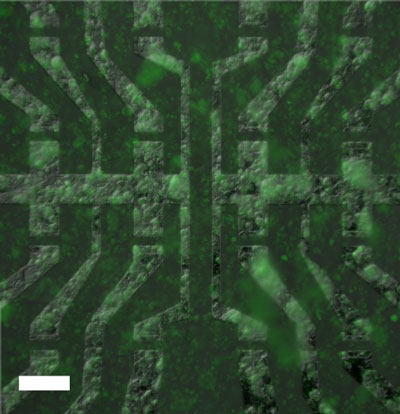
| Intestinal cell monolayer after exposure to nanoparticles, shown in green. (Credit: Image courtesy of Cornell University)caption |
According to the study, high-intensity, short-term exposure to the particles initially blocked iron absorption, whereas longer-term exposure caused intestinal cell structures to change, allowing for a compensating uptick in iron absorption.
Full article on the Science Daily link above
Friday, 17 February 2012
One outfit, any colour you like, instantly.
In the Story, Alister acquires camo-dye made from quasicrystals. With controlled electrical charges, the crystals 'defect' property can be manipulated to change colour. Here's the catalyst for the idea.
From Science Daily (16 Feb, 2012) Strange New Nano-Region Can Form in Quasicrystals
"In crystals, a "defect" refers to any departure from perfect structural symmetry. While the term suggests an undesirable quality, not all defects are bad; many control or influence key material properties, such as chemical purity, mechanical strength, conductivity, color, corrosivity or surface properties.
Rubies, for instance, are red due to a defect that turns an otherwise non-descript crystal into a valuable gem."
Thursday, 16 February 2012
Robugs by the millions
ScienceDaily (Feb. 15, 2012) — A new technique inspired by elegant pop-up books and origami will soon allow clones of robotic insects to be mass-produced by the sheet.
Devised by engineers at Harvard, the ingenious layering and folding process enables the rapid fabrication of not just microrobots, but a broad range of electromechanical devices.
Subscribe to:
Posts (Atom)