Tuesday, 8 November 2011
Nanoskin for your touchy, feely android (or exosuit)
A team at Stanford's Bao Research Group have developed artificial skin. This is a stretchable, transparent skin-like sensor that is elastic and can also sense touch and pressure like the real thing.


Sunday, 6 November 2011
Cybercrime, a multibillion dollar business!
To stop cybercrime we need to think like the criminals http://gu.com/p/335bz
The Guardian has a pretty good artice on how the UK is progressing and working on tackling cybercrime

"Efforts to combat cybercrime concentrate on enhanced security, but intercepting the kids drawn into its web might prove better"
A multi-billion dollar business, a recession, thousands kicked from work every week, no jobs for kids. Hmm, The govt's got its work cut out!
The Guardian has a pretty good artice on how the UK is progressing and working on tackling cybercrime

"Efforts to combat cybercrime concentrate on enhanced security, but intercepting the kids drawn into its web might prove better"
A multi-billion dollar business, a recession, thousands kicked from work every week, no jobs for kids. Hmm, The govt's got its work cut out!
Popularity of nanotechnology taking off
Community Day at UAlbany NanoCollege draws largest-ever crowd to explore nanotechnology
 (Nanowerk News) A record crowd of more than 1,200 visitors of all ages from throughout New York State received an inside look at the exciting world of nanotechnology today when they participated in Community Day at the College of Nanoscale Science and Engineering (CNSE) of the University at Albany, one of the highlights of CNSE's one-of-a-kind community and educational outreach initiative known as "NANOvember."
Here's the link to Nanovember
Here's the link to Nanovember
Wednesday, 2 November 2011
No Hiding Place
Thinking of taking your computer or smartphone abroad? You can safely assume that at any point, a government 'cyber-crime or anti-terrorist team can hack into your computer to see what you are up to.
Just dont accidentally snap.a picture of a secret government building or agent, or email/chat/sms something disrespectful while you are out there.
Governments turn to hacking techniques for surveillance of citizens http://gu.com/p/33357
Tuesday, 1 November 2011
A "Small" History of Nanotechnology
For those of you flummoxed by all this nanotechnology stuff, here's one of the best sites around for a fascinating and very readable introduction to nanotechnology and how it all kicked off.

"The site explores and presents information on technological activities (and their associated social implications) that have the capacity to not only enhance our survival probability as a species, but to improve the quality of life as we move along the evolutionary path. We are non-partisan, and are neither anti nor pro-religious, preferring to remain open or at least tolerant regarding theories and beliefs which can be neither proven nor refuted scientifically. We are proponents of science and technology in the sense of being realists in recognizing that technology is coming whether we as a species or whether any one of us as an individual like it or not, and believe that the most effective action we can take is to learn more about technology in order to collectively guide its proper use toward a positive future. This site is intended primarily for the layperson, and is both factual and speculative in nature. It uses the interdisciplinary relationship of several main sciences to explore human advancement "
DNA synthesis and nanotechnology.
The nanoparticles inside Alister were readily absorbed by him because they contained elements of his DNA signature.
The possibility of creating nanoparticles with complex functionality such as interfacing with the human nervous system and able to network wirelessly, powered by the bodies own energy requires the convergence of several different technologies. nanotechnology obviously and manipulation of DNA.
Success in both these fields is progressing faster with each new discovery and innovation.
But convergence is always the rule.
Here we have news of DNA being synthesised and folded into unique nanoscale structures - another step in the building blocks to complex nanoparticles operating within the nervous system
(Nanowerk News) In the emerging field of synthetic biology, engineers use biological building blocks, such as snippets of DNA, to construct novel technologies. One of the key challenges in the field is finding a way to quickly and economically synthesize the desired DNA strands. Now scientists from Duke University have fabricated a reusable DNA chip that may help address this problem by acting as a template from which multiple batches of DNA building blocks can be photocopied. The researchers have used the device to create strands of DNA which they then folded into unique nanoscale structures.
Add this development to my other blog post and you begin to get the picture of how the convergence of nanotechnology, DNA creation and genetic manipulation is creating an environment for a revolutionary surge in human evolution.

The possibility of creating nanoparticles with complex functionality such as interfacing with the human nervous system and able to network wirelessly, powered by the bodies own energy requires the convergence of several different technologies. nanotechnology obviously and manipulation of DNA.
Success in both these fields is progressing faster with each new discovery and innovation.
But convergence is always the rule.
Here we have news of DNA being synthesised and folded into unique nanoscale structures - another step in the building blocks to complex nanoparticles operating within the nervous system
(Nanowerk News) In the emerging field of synthetic biology, engineers use biological building blocks, such as snippets of DNA, to construct novel technologies. One of the key challenges in the field is finding a way to quickly and economically synthesize the desired DNA strands. Now scientists from Duke University have fabricated a reusable DNA chip that may help address this problem by acting as a template from which multiple batches of DNA building blocks can be photocopied. The researchers have used the device to create strands of DNA which they then folded into unique nanoscale structures.
Add this development to my other blog post
In the Spring of 2008 Scripps College ran an excellent and inspiring series of events entitled: Human Evolution 2.0: Biotechnology and the Future of Human Nature (Spring 2008)
Below is the full text from the web page. I recommend you check out the page here

At the start of the 21st century, we find ourselves on the threshold
of a new age in which rapidly converging biosciences and technologies
(genomics, genetic engineering, cloning, stem cell research, artificial
reproduction, neurotechnologies, artificial intelligence, robotics,
information technology, and nanotechnology) have the potential to not
only dramatically increase our understanding of human life, but also
radically transform human nature itself.
At stake in this biotech revolution is not simply the greater control
we might gain over our biological limitations (by treating diseases,
alleviating pain, slowing the aging process, etc.), but, beyond these
therapeutic benefits, what is at stake is the power to determine the
future of our species as humans. The potential development of "designer
babies," synthetic genes, genetic interventions, augmented cognitive
powers, cyborgs, and of all forms of human enhancement technologies
raise both hopes and fears. Will these developments make us better
humans? Will they inalterably change what it means to be human? Or will
they make the very notion of human nature obsolete? To help us consider
the promises and risks of emerging biotechnologies, we are inviting
scientists, social scientists, legal scholars, bioethicists, and
neuroethicists to discuss with us the moral, social, legal, economic and
political implications of the new biosciences.
View Events, Lectures, and Series Information
View Events, Lectures, and Series Information
Sunday, 30 October 2011
Shape Shifting Nanomaterials
Technology continues to moves towards achieving the gear and gizmos you'll find in \Cloud.
The article Shape shifting nanomaterials. gives an account of nanomaterials that change the geometry of a nanomaterial. The scientists who developed the material described their method as "just like building different types of houses with the same bricks and tiles,"
 The material is currently only able to generate two-dimensional molecular porous networks with a systematically adjustable structure using the hierarchical formation of hydrogen bonds.
This development is one possible small element in the path towards the creation of a 'Soft-Machine' outfit used by Alister.
("Two-Dimensional Molecular Porous Networks Formed by Trimesic Acid and 4,4'-Bis(4-pyridyl)biphenyl on Au(111) through Hierarchical Hydrogen Bonds: Structural Systematics and Control of Nanopore Size and Shape").
The article Shape shifting nanomaterials. gives an account of nanomaterials that change the geometry of a nanomaterial. The scientists who developed the material described their method as "just like building different types of houses with the same bricks and tiles,"
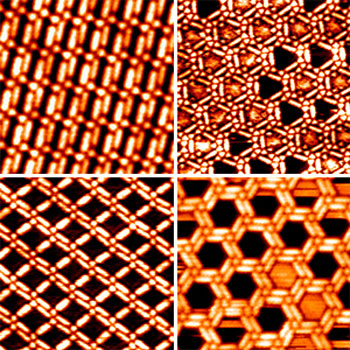
This development is one possible small element in the path towards the creation of a 'Soft-Machine' outfit used by Alister.
("Two-Dimensional Molecular Porous Networks Formed by Trimesic Acid and 4,4'-Bis(4-pyridyl)biphenyl on Au(111) through Hierarchical Hydrogen Bonds: Structural Systematics and Control of Nanopore Size and Shape").
Saturday, 29 October 2011
\Cloud. And you thought it was all Science Fiction
Michael Berger provides a very readable account of progress in the field of nanotechnology and neuroscience.
Here's a cut and paste of just one small section.
What is already reality today is something called neuroprosthetics, an area of neuroscience that uses artificial microdevices to replace the function of impaired nervous systems or sensory organs. Different biomedical devices implanted in the central nervous system, so-called neural interfaces, already have been developed to control motor disorders or to translate willful brain processes into specific actions by the control of external devices.
I strongly recommend you click and read the full article here: Nanotechnology coming to a brain near you Michael Berger, (Copyright 2007 Nanowerk LLC),
Nanoparticles have been around and in your system for quite a while already
Nanotechnology Today: If you've ever eaten from silverware or worn copper jewelry, you've been in a perfect storm in which nanoparticles were dropped into the environment
Using a new approach developed at UO that allows for the direct observation of microscopic changes in nanoparticles over time, researchers found that silver nanoparticles deposited on the surface of their SMART Grids electron microscope slides began to transform in size, shape and particle populations within a few hours, especially when exposed to humid air, water and light. Similar dynamic behavior and new nanoparticle formation was observed when the study was extended to look at macro-sized silver objects such as wire or jewelry.
"Our findings show that nanoparticle 'size' may not be static, especially when particles are on surfaces. For this reason, we believe that environmental health and safety concerns should not be defined -- or regulated -- based upon size," said James E. Hutchison, who holds the Lokey-Harrington Chair in Chemistry.
Monday, 17 October 2011
headsets that pick up your thoughts
The BBC news item about headsets you can wear that pick up your brainwaves and allow you to manipulate some kind of machinery via a wireless link are the first step to the nanoparticles inside Alister.
Shrinking these sensors down by bioengineering organo-synthetic nanoparticles that can collectively generate a signal is a logical next step.
You may think this is all pretty far fetched but the truth is that we are already victims of the reckless use of nanomaterials in all kinds of manufactured stuff we handle.
Developing technologies that start to control the kinds of nanomaterials manufactured for direct human absorption and controlling how we are dosed up with them isn't far behind. We are already seeing research into the application of nanomedicines. You can read all about these developments in Nanomedicine
The article How Nanoparticles Enter the Human Body and Their Effects There (nanotrust dossier 003 November 2010. Published by the Institute of Technology Assessment of the Austrian Academy of Sciences, gives a very readable account of the reality of how easy it is to get nanoparticles in the human body
Here's a cut-n-paste of the introduction paragraph (My italics)
"Nanotechnology and the respective nanomaterials are employed in the research sector and also contained in many commercially available products. This means that the general public is currently being exposed to nanomaterials. This raises the question whether such materials enter the human body and whether they can trigger health effects. The potential health risks are poorly investigated. A number of studies have reported that free nanoparticles, due to their small size, can penetrate into the finest lung structures by breathing, can cause inflammatory reactions, and subsequently can enter the bloodstream. The circulatory system distributes such particles throughout the body, where they can enter other organs. Nanoparticles can also be actively or passively incorporated in cells, and harmful effects cannot be excluded. The biological effects are not based on chemical composition alone: size, shape, surface texture, aggregation state and surface charge also play an important role. The present dossier examines the potential entry sites of nanoparticles into the human body and describes several biological effects which can be triggered"
Image below from nanomedicine.

Saturday, 15 October 2011
Carbon Nanotube Muscles

ScienceDaily (Oct. 14, 2011) — New artificial muscles that twist like the trunk of an elephant, but provide a thousand times higher rotation per length, have been developed by a team of researchers from The University of Texas at Dallas, The University of Wollongong in Australia, The University of British Columbia in Canada, and Hanyang University in Korea.
(This is a scanning electron micrograph image of a 3.8-micron diameter carbon nanotube yarn that functions as a torsional muscle when filled with an ionically conducting liquid and electrochemically charged. The angle ± indicates the deviation between nanotube orientation and yarn direction for this helical yarn. (Credit: Image courtesy of the University of Texas at Dallas))
The thickness of the Soft-Machine fabric worn by Alister is due to the complex interweaving of several semi-fluid 'fabrics' each with unique properties such as thermal, regulation, strength enhancing, light sensitivity, electromagnetism, energy conversion, short-term data storage.
The critical function of networking is what makes the entire outfit function. The constant flow of design data from the Janus Supercomputer ensures the fabrics retain structural integrity when inactive and when functioning in concert with other fabrics that make up the outfit
Rainwear That Repairs Itself?

In co-operation with research scientists and industry colleagues in eight countries, Susie Jahren and her project team are developing the clothing of the future for professional fishermen. Midway in the EU project "Safe@Sea," the SINTEF team has high hopes of ending up with a world first: at textile coating which automatically seals small holes and tears in the surface layer of waterproof work-wear.
More on the jump >Here<
Subscribe to:
Posts (Atom)