Tuesday, 13 December 2011

Scientists close to 'Matrix' style instant learning


Scientists say they’re getting closer to Matrix-style instant learning

What price effortless learning? In a paper published in the latest issue of Science, neuroscientists say they've developed a novel method of learning, that can cause long-lasting improvement in tasks that demand a high level of visual performance.

And while the so-called neurofeedback method could one day be used to teach you kung fu, or to aid spinal-injury patients on the road to rehabilitation, evidence also suggests the technology could be used to target people without their knowledge, opening doors to numerous important ethical questions.
Read the mere-mortal friendly article here

New Research: E produces lasting brain toxicity

Ecstasy drug produces lasting toxicity in the brain

ScienceDaily (Dec. 5, 2011) — Recreational use of Ecstasy -- the illegal "rave" drug that produces feelings of euphoria and emotional warmth -- is associated with chronic changes in the human brain, Vanderbilt University investigators have discovered.

Cowan and colleagues reported earlier this year that Ecstasy increased brain activation in three brain areas associated with visual processing, which suggested a loss in brain efficiency. Together, the two studies provide compelling evidence that Ecstasy causes lasting changes in brain serotonin function, Cowan said.

Monday, 12 December 2011

Quantum computers - a big step closer

Multi-purpose photonic chip paves the way to programmable quantum processors

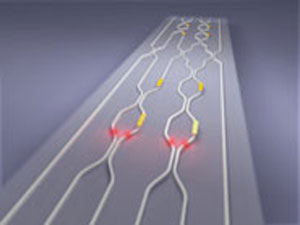
(Nanowerk News) A multi-purpose optical chip which generates, manipulates and measures entanglement and mixture - two quantum phenomena which are essential driving forces for tomorrow's quantum computers - has been developed by researchers from the University of Bristol's Centre for Quantum Photonics. This work represents an important step forward in the race to develop a quantum computer.
More on the >Jump Here<

Thursday, 8 December 2011

Record massive black holes discovered lurking in monster galaxies

Record massive black holes discovered lurking in monster galaxies
ScienceDaily (Dec. 5, 2011) — University of California, Berkeley, astronomers have discovered the largest black holes to date ‑- two monsters with masses equivalent to 10 billion suns that are threatening to consume anything, even light, within a region five times the size of our solar system.

Monday, 5 December 2011

The New Soft-Machine


The Soft Machine was published by Willaim S Burroughs in 1961. The title of the book refers to the human body.
In the present day, the possibility nanotechnology offers to ways of manipulating the human body and the way it repairs itself, how we communicate with others and with technology, increase our physical and mental abilities - all truly reframe our bodies as nothing more than a Soft Machine; an instrument to be engineered and enhanced according to our wishes and desires. It is no longer science fiction. It is happening.

NeuroScience - watching your brain at work.

Neuroscience is on a steep research learning scan with Functional Imaging, watching the brain at work in real time to see what's going on where in the brain when we are thinking or reacting to situations.
There are moves to have such results 'analysed' and presented in a court as evidence.
But there are greater dangers ahead.
Nanotechnology is developing targeted treatments for a whole host of diseases and conditions.
It is feasibly possible that behaviour modifying treatments  - including DNA engineered nanoparticles that can target specified parts of the brain to modify 'abnormal' reactions will be developed in the near future. Treatments for epilepsy, Parkinsons and paralysis are already being explored.

Here's a link to the MP3 file
Scanning the brains of psychopathic 'callous'  / unemotional children, and criminals - 


David DiSalvo offers a strong argument outlining the dangers of rushing into using a new science to assist the legal system in determining 'The Truth' "Five Reasons Neuroscience is not ready for the Courtroom."

Wednesday, 30 November 2011

Fancy Nanoparticles cleaning your blood?

Researchers in Zurich, Switzerland, are developing nanomagnets that could someday strip potentially harmful substances from the blood. The technology might be used to treat people suffering from drug intoxication, bloodstream infections, and certain cancers.
Tiny Magnets Could Clear Disease from the Blood

Tuesday, 29 November 2011

New Software for nanoscale designs target global industries


(Nanowerk News) Accelrys, Inc  has announced the release of Materials Studio® 6.0 a State-of-the-art modelling and simulation environment that combines the accuracy of quantum methods with the speed of atomistic methodologies. 
"Nanoscience will play a key role in the next generation of materials used in automobiles, aircraft, electronics and many other industries," said Professor Bjoern Winkler of the University of Frankfurt. "Materials Studio provides us with the computational science we need to help understand and develop these materials and this release is the most powerful yet."
Read the full article
Accelrys' Materials Studio Makes Big Impact with "Small" Science

For a wealth of information and resources, check out The Accerlys Website

Friday, 25 November 2011

Carbon nanotube forest camouflages 3-D objects

Carbon Nanotube Forest Camouflages 3-D Objects
ScienceDaily (Nov. 21, 2011) — Carbon nanotubes, tiny cylinders composed of one-atom-thick carbon lattices, have gained fame as one of the strongest materials known to science. Now a group of researchers from the University of Michigan is taking advantage of another one of carbon nanotubes' unique properties, the low refractive index of low-density aligned nanotubes, to demonstrate a new application: making 3-D objects appear as nothing more than a flat, black sheet.

Thursday, 24 November 2011

Aww, Real Little Cyborgs - or is that Cybugs?

Efforts to create an army of cyborg insects are being pursued by a team of US-based engineers.
The group is investigating ways to harvest energy from the creatures to power sensors and other equipment fastened to their bodies.
The team has created an energy scavenging device that is attached close to the insects' wings.

LHC antimatter anomaly hints at new physics

LHC antimatter anomaly hints at new physics - physics-math - 23 November 2011 - New Scientist
"The Large Hadron Collider has turned up differences in how particles of matter and antimatter decay that the reigning standard model of physics may not be able to explain
WE ARE here thanks to a curious imbalance in the universe. To the best of our knowledge, the universe began with equal, or nearly equal, amounts of matter and antimatter. Because these particles annihilate on contact, they should have destroyed each other long ago in a blaze of radiation, leaving little if anything behind to form stars, planets and people. Clearly, that didn't happen.
The hunt for the special something that might have skewed the universe in favour of matter occupies the best minds in physics. Compelling signs of such lopsided physics have emerged at the Large Hadron Collider at CERN near Geneva in Switzerland. It is the first sign of new physics at the LHC and could provide a boost for the theory of supersymmetry, which adds a zoo of new particles to the ones we already know. "We are getting excited," says Yuval Grossman of Cornell University in Ithaca, New York."

Tuesday, 22 November 2011

Can't get enough reality?

From the BBC
A new generation of contact lenses that project images in front of the eyes is a step closer after successful animal trials, say scientists.

The technology could allow wearers to read floating texts and emails or augment their sight with computer-generated images, Terminator-style.Initial safety tests in rabbits have gone well, with no obvious adverse effects, the researchers have renewed faith about the device's possibilities.
They envisage hundreds more pixels could be embedded in the flexible lens to produce complex holographic images. For example, drivers could wear them to see journey directions or their vehicle's speed projected onto the windscreen. Similarly, the lenses could take the virtual world of video gaming to a new level."

Monday, 21 November 2011

Illinois water system easily hacked

Hacker busts water supply by getting in via the 3 letter password.
Bet it was H2O!

Hackers 'attack' US water system