Tuesday, 20 December 2011

Climate Change & Big Ecosystem Shifts - NASA


"ScienceDaily (Dec. 18, 2011) — By 2100, global climate change will modify plant communities covering almost half of Earth's land surface and will drive the conversion of nearly 40 percent of land-based ecosystems from one major ecological community type -- such as forest, grassland or tundra -- toward another, according to a new NASA and university computer modeling study....

While Earth's plants and animals have evolved to migrate in response to seasonal environmental changes and to even larger transitions, such as the end of the last ice age, they often are not equipped to keep up with the rapidity of modern climate changes that are currently taking place. Human activities, such as agriculture and urbanization, are increasingly destroying Earth's natural habitats, and frequently block plants and animals from successfully migrating."


More on the >Jump Here<

Decisions decisions, Neuroeconomics.

Would you sacrifice a life to save four?
If you had to choose which orphan ate and which did not, what would guide your judgements?

Friday, 16 December 2011

You will be nano-assimilated sooner than you think.


Free DNA Nanotechnology Podcast
From a biological perspective, DNA is the language for life. But what may be less widely known is DNA’s potential as a programmable building block at the nanoscale. In this podcast, Hughes discusses DNA’s potential as an engineering material for building structural scaffolds for nanoelectronic devices and biochemical tools for diagnosing disease. With grants from the W.M. Keck Foundation, the National Institutes of Health , the National Science Foundation , and the Defense Advanced Research Projects Agency, Hughes and his colleagues in the Nanoscale Materials & Device Research Group are pursuing DNA nanotechnology as a future manufacturing process.

Okay, so if you've read the other postings here, you'd know about the ease with which nanoparticles can enter our system, right through our skin or by being breathed in.
So what the hell is going to happen when these DNA manufactured nanoparticles find their way into our system? Theyr'e gonna love the variety of warm soupy goo under our skin and who knows what they'll start mutating up just 'cos they can.

It's bad enough that with all the toxins we come across in everyday products, things like bleaches, household cleansers, fire-retardants in fabrics, chemicals in fuel, packaging - it's easy enough to scoop up more than the maximum limit. And as we all know the deadliest of all the hundreds of toxic additives in cigarettes - all help make our bodies little cancer factories.

But now we have to look to the possible DNA-nanotechnolgy mash ups that might find our bodies a useful little playground to mess around in.

Is there a regulatory body with sufficient resources and legal clout to make sure the corporations don't put profit before public health?

Thursday, 15 December 2011

Ability to Love Takes Root in Earliest Infancy

Sure, I'm an old romantic. So I couldn't avoid posting this one

ScienceDaily (Dec. 14, 2011) — The ability to trust, love, and resolve conflict with loved ones starts in childhood -- way earlier than you may think. That is one message of a new review of the literature in Current Directions in Psychological Science, a journal published by the Association for Psychological Science.
""Your interpersonal experiences with your mother during the first 12 to 18 months of life predict your behavior in romantic relationships 20 years later," says psychologist Jeffry A. Simpson, the author, with University of Minnesota colleagues W. Andrew Collins and Jessica E. Salvatore. "Before you can remember, before you have language to describe it, and in ways you aren't aware of, implicit attitudes get encoded into the mind," about how you'll be treated or how worthy you are of love and affection."

Wednesday, 14 December 2011

Richard Dawkins Foundation for Research and Science

RichardDawkins.net
A rich resource of articles and videos. bookmark it and add the rss to your feeds.

Tuesday, 13 December 2011

What is a Higgs Boson?

Fermilab scientist Don Lincoln describes the nature of the Higgs boson. Several large experimental groups are hot on the trail of this elusive subatomic particle which is thought to explain the origins of particle mass

Nano-Electric Power Generation


http://nanoholdings.com/ - Justin Hall-Tipping CEO of "Nanoholdings" Explains how nanotechnology is set to change the future of energy and replace fossil and nuclear fuels: 

Scientists close to 'Matrix' style instant learning


Scientists say they’re getting closer to Matrix-style instant learning

What price effortless learning? In a paper published in the latest issue of Science, neuroscientists say they've developed a novel method of learning, that can cause long-lasting improvement in tasks that demand a high level of visual performance.

And while the so-called neurofeedback method could one day be used to teach you kung fu, or to aid spinal-injury patients on the road to rehabilitation, evidence also suggests the technology could be used to target people without their knowledge, opening doors to numerous important ethical questions.
Read the mere-mortal friendly article here

New Research: E produces lasting brain toxicity

Ecstasy drug produces lasting toxicity in the brain

ScienceDaily (Dec. 5, 2011) — Recreational use of Ecstasy -- the illegal "rave" drug that produces feelings of euphoria and emotional warmth -- is associated with chronic changes in the human brain, Vanderbilt University investigators have discovered.

Cowan and colleagues reported earlier this year that Ecstasy increased brain activation in three brain areas associated with visual processing, which suggested a loss in brain efficiency. Together, the two studies provide compelling evidence that Ecstasy causes lasting changes in brain serotonin function, Cowan said.

Monday, 12 December 2011

Quantum computers - a big step closer

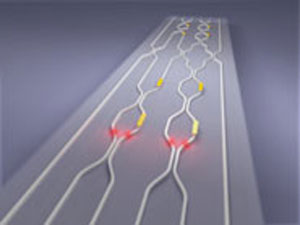
Multi-purpose photonic chip paves the way to programmable quantum processors

(Nanowerk News) A multi-purpose optical chip which generates, manipulates and measures entanglement and mixture - two quantum phenomena which are essential driving forces for tomorrow's quantum computers - has been developed by researchers from the University of Bristol's Centre for Quantum Photonics. This work represents an important step forward in the race to develop a quantum computer.
More on the >Jump Here<

Thursday, 8 December 2011

Record massive black holes discovered lurking in monster galaxies

Record massive black holes discovered lurking in monster galaxies
ScienceDaily (Dec. 5, 2011) — University of California, Berkeley, astronomers have discovered the largest black holes to date ‑- two monsters with masses equivalent to 10 billion suns that are threatening to consume anything, even light, within a region five times the size of our solar system.

Monday, 5 December 2011

The New Soft-Machine


The Soft Machine was published by Willaim S Burroughs in 1961. The title of the book refers to the human body.
In the present day, the possibility nanotechnology offers to ways of manipulating the human body and the way it repairs itself, how we communicate with others and with technology, increase our physical and mental abilities - all truly reframe our bodies as nothing more than a Soft Machine; an instrument to be engineered and enhanced according to our wishes and desires. It is no longer science fiction. It is happening.

NeuroScience - watching your brain at work.

Neuroscience is on a steep research learning scan with Functional Imaging, watching the brain at work in real time to see what's going on where in the brain when we are thinking or reacting to situations.
There are moves to have such results 'analysed' and presented in a court as evidence.
But there are greater dangers ahead.
Nanotechnology is developing targeted treatments for a whole host of diseases and conditions.
It is feasibly possible that behaviour modifying treatments  - including DNA engineered nanoparticles that can target specified parts of the brain to modify 'abnormal' reactions will be developed in the near future. Treatments for epilepsy, Parkinsons and paralysis are already being explored.

Here's a link to the MP3 file
Scanning the brains of psychopathic 'callous'  / unemotional children, and criminals - 


David DiSalvo offers a strong argument outlining the dangers of rushing into using a new science to assist the legal system in determining 'The Truth' "Five Reasons Neuroscience is not ready for the Courtroom."