I write Scifi. I've moved the blog to http://www.softmachine.net You'll find all the new stuff there @NathanMcGrathSF. Nathan.
Thursday, 5 January 2012
Fishy nano-tales. Salmon DNA nano-engineered for data storage and illumination.
>(Nanowerk News)< A group of researchers from National Tsing Hua University in Taiwan and the Karlsruhe Institute of Technology in Germany have created a "write-once-read-many-times" (WORM), DNA-based memory device that uses ultraviolet (UV) light to encode information.
The device consists of a thin film of salmon DNA embedded with silver nanoparticles and sandwiched between two electrodes. Shining UV light on the system triggers a synthesis process that causes the silver atoms to cluster into nano-sized particles, and readies the system for data encoding.
At first, when no voltage or low voltage is applied through the electrodes to the UV-irradiated DNA, only a low current is able to pass through the composite; this corresponds to the "off" state of the device.
However, the UV irradiation makes the composite unable to hold charge under a high electric field, so when the applied voltage exceeds a certain threshold, an increased amount of charge is able to pass through. This higher state of conductivity corresponds to the "on" state of the device.
Once information is written, the device appears to retain that information indefinitely. The material's conductivity did not change significantly during nearly 30 hours of tracking.
The authors hope the technique will be useful in the design of optical storage devices and suggest that it may also have plasmonic applications.
DNA may be less expensive to process into memory devices than using traditional, inorganic materials like silicon, the researchers say.
Elsewhere
Salmon DNA Makes Better Lighting
Andrew Steckl, director of the Nanoelectronics Laboratory at the University of Cincinnati, is using salmon sperm DNA to create a new type of light-emitting diode (LED), the energy-efficient bulb used in everything from watches to Christmas-tree lights. By using DNA strands to isolate more luminophores—the molecules that generate light within LEDs—Steckl can produce LED bulbs that are 10 times brighter and last three to five times longer than current versions.
>Bloomberg Business Week<
Wednesday, 4 January 2012
Tuesday, 3 January 2012
Want to be a real Sim? here's your chance.
Will Wright, the designer of 'The Sims, wants to transform your life into a game.
An article in the Reuters website has the full story. here are a couple of snippets.
"HiveMind," a group of cross-platform, cross-media online applications, is designed to turn a gamer's everyday life into part of the interactive experience by building upon Alternate Reality Games (ARGs) and tapping into streams of personal information on phones, tablets, social networks and computers.
"I realized that we could build a system -- if we had a situational awareness about you, about who you are, where you are, what time of day it is, how much money is in your pocket, what's the weather like, what your interests are, etc. -- that could make your life much more interesting."
Sure, why not just dump everything about you into someone's server.
Just think how much money Mr Wright will make from selling Anonymised data on what people get up to in real time. By this I mean data that cannot identify any person individually but is invaluable to marketing and advertising firms.
Most men/women aged x/y would prefer to buy / do 'this' in these given situations / range of choices, etc etc.
There's no need for him to sell any personal data at all.
Basically players will become Sims with A.I in a game played by Mr Wright and his clients.
Mind reading Computer?
ScienceDaily (Dec. 21, 2011) — At UCLA's Laboratory of Integrative Neuroimaging Technology, researchers use functional MRI brain scans to observe brain signal changes that take place during mental activity. They then employ computerized machine learning (ML) methods to study these patterns and identify the cognitive state -- or sometimes the thought process -- of human subjects. The technique is called "brain reading" or "brain decoding."
More on the jump >Here<
Sunday, 1 January 2012
There's lots of free space up there
Hackers prepare space satellites
This is the first best news of 2012. Personally, if I could, I'd pay to support a service like this.
Thursday, 29 December 2011
Interactive view of Graphene Moelcule
Here's a pretty neat way to explore one of the next big things that will transform most of the everyday stuff in our lives. An Interactive Graphene Molecule
In 2010 the Nobel Prize in Physics was awarded to Andre Geim and Konstantin Novoselov "for groundbreaking experiments regarding the two-dimensional material graphene".
Wednesday, 28 December 2011
Light up your brain
How the Brain Cell Works: A Dive Into Its Inner Network
ScienceDaily (Dec. 21, 2011) — University of Miami (UM) biology professor Akira Chiba is leading a multidisciplinary team to develop the first systematic survey of protein interactions within brain cells. The team is aiming to reconstruct genome-wide in situ protein-protein interaction networks (isPIN) within the neurons of a multicellular organism. Preliminary data were presented at the American Society for Cell Biology annual meeting, December 3 through 7, 2011, in Denver, Colorado.
Neurons are the cells that are mainly responsible for signaling in the brain. Like all other cells, each neuron produces millions of individual proteins that associate with one another and form a complex communication network.
Protest or lose your rights to Freedom of Speech
This message is an immediate call for a day of action. On January 3rd, the collective is calling upon the citizens of the united states to protest against the new sections in the national defense authorization act that were passed a short while ago. This law will strip away many rights; including, but not limited to, Free speech, Free press, Free access to information, and the right to protest, assemble, and bear arms. This law cannot be changed according to the Feinstein Act.
Sections Ten thirty one and ten thirty two of the national defense authorization act grants unlimited powers to the executive branch of the government to indefinitly detain suspects, even American citizens, without trial. All a person has to do is to commit a belligerent act.
There's the real danger; what is a belligerent act? Is protesting a belligerent act? When is any kind of protest not a belligerent act? Who decides? How will YOU be able to judge whether any kind of protest you want to make - to any authority about their conduct or treatment of yourself or another mistreated citizen is fair and legitimate?
Is being Anonymous a belligerent act?
U.S Citizens sign the petition here
From Wikipedia:
Controversy
Section 1021 and 1022, controversial to the general public, were perceived as threats to the Bill of Rights and the freedoms of America. They allow for the indefinite military detention of potential terrorists, challenging the general judicial status of "innocent until proven guilty." This most recent addition of the NDAA has critics that say it puts not only civil liberties in danger but also that it is an aggressive but futile attack in the War on Terror. Despite the act passing overwhelmingly, it is viewed by many as a large threat to the privileges of American citizens. Addressed by many major publications negatively, it also received a direct video message from Anonymous in an attempt to expose the chicanery of the act and its potential consequences. [22] [23] In addition, an online petition requesting that President Obama veto the bill was created on the "We The People" section of the White House website. As of December 27, 2011, the petition required 7,730 signatures by December 30th to reach the site's petition threshold. [24]
Monday, 26 December 2011
Mind Control using light wavelengths
Oh Dear, the paranoids nightmare - forget the Aluminum caps, hacking and tapped phones. 'They' just need to dose you with DNA that creates the Neuron triggers to respond to the wavelength signals.
You'll eat pure organic and never watch another advert again now will you?
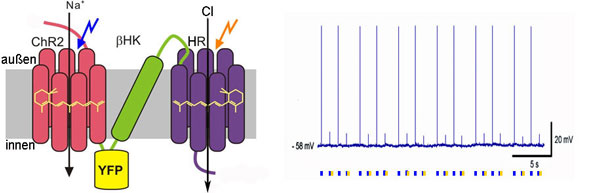
(Nanowerk News) Since the dawn of optogenetics, scientists can turn nerve cells on and off using pulses of light. A research team at the Max Planck Institute of Biophysics in Frankfurt am Main has developed a molecular light switch that makes it possible to control cells more accurately than ever before (see paper in Nature Methods: "A gene-fusion strategy for stoichiometric and co-localized expression of light-gated membrane proteins").
The combination switch consists of two different light-sensitive membrane proteins – one for on, the other for off. The method used by the scientists to connect the two components can be used with different protein variants, making it highly versatile. Optogenetics is a new field of research that aims to control cells using light. To this end, scientists avail of light-sensitive proteins that occur naturally in the cell walls of certain algae and bacteria. They introduce genes with the building instructions for these membrane proteins into the DNA of target cells. Depending on which proteins they use, they can fit cells with on and off switches that react to light of different wavelengths.
You'll eat pure organic and never watch another advert again now will you?
(Nanowerk News) Since the dawn of optogenetics, scientists can turn nerve cells on and off using pulses of light. A research team at the Max Planck Institute of Biophysics in Frankfurt am Main has developed a molecular light switch that makes it possible to control cells more accurately than ever before (see paper in Nature Methods: "A gene-fusion strategy for stoichiometric and co-localized expression of light-gated membrane proteins").
The combination switch consists of two different light-sensitive membrane proteins – one for on, the other for off. The method used by the scientists to connect the two components can be used with different protein variants, making it highly versatile. Optogenetics is a new field of research that aims to control cells using light. To this end, scientists avail of light-sensitive proteins that occur naturally in the cell walls of certain algae and bacteria. They introduce genes with the building instructions for these membrane proteins into the DNA of target cells. Depending on which proteins they use, they can fit cells with on and off switches that react to light of different wavelengths.
Friday, 23 December 2011
Enter the nano-world
You really must check this out. Nanoreisen had an interactive guide that takes you step by step into the nanoworld in your body and technology.
A virtual discovery journey into the worlds of micro- and nano-cosmos. On various routes you can gradually "shrink yourself" into worlds invisible to us and penetrate into the smallest known dimensions of our universe.
The Inner Life of a Cell.
The Inner Life of a Cell, an eight-minute animation created in NewTek LightWave 3D and Adobe After Effects for Harvard biology students. Created by XVIVO, a scientific animation company near Hartford, CT, the animation illustrates unseen molecular mechanisms and the ones they trigger, specifically how white blood cells sense and respond to their surroundings and external stimuli.
Tuesday, 20 December 2011
Climate Change & Big Ecosystem Shifts - NASA
"ScienceDaily (Dec. 18, 2011) — By 2100, global climate change will modify plant communities covering almost half of Earth's land surface and will drive the conversion of nearly 40 percent of land-based ecosystems from one major ecological community type -- such as forest, grassland or tundra -- toward another, according to a new NASA and university computer modeling study....
While Earth's plants and animals have evolved to migrate in response to seasonal environmental changes and to even larger transitions, such as the end of the last ice age, they often are not equipped to keep up with the rapidity of modern climate changes that are currently taking place. Human activities, such as agriculture and urbanization, are increasingly destroying Earth's natural habitats, and frequently block plants and animals from successfully migrating."
More on the >Jump Here<
Subscribe to:
Posts (Atom)